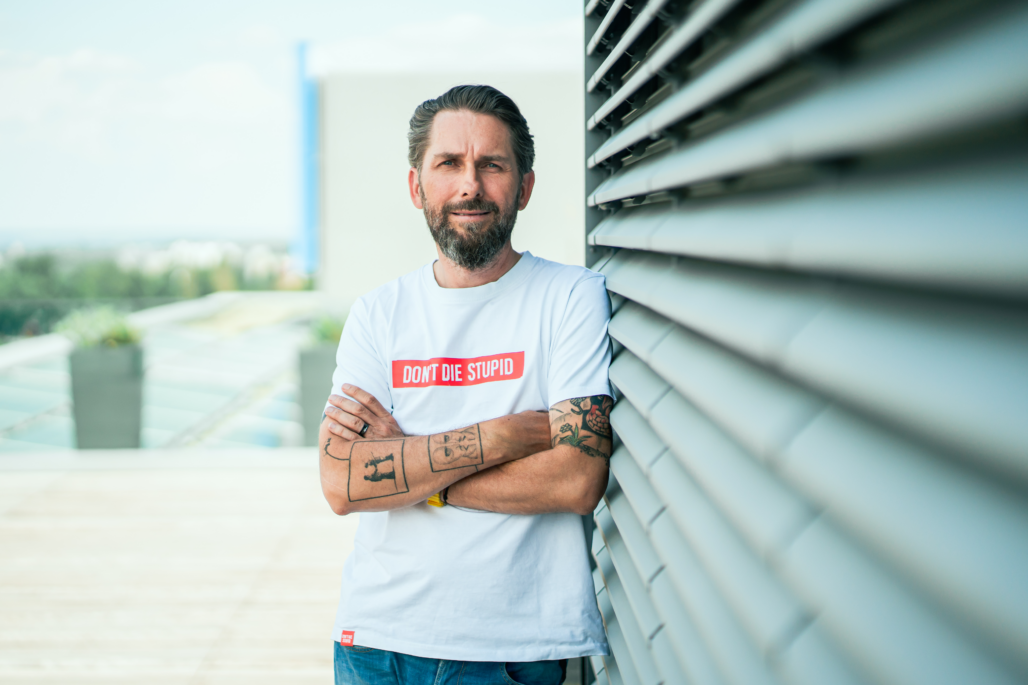
Success comes in many forms. It’s not just startups that are conquering the market with innovative ideas, but also individuals who choose to change the world around them, whether they are entrepreneurs, scientists, students or philanthropists. Sometimes all it takes is a bold idea, other times it takes years of persistent work. But they have one thing in common – they don’t give up, they look for new ways and push the boundaries of possibility with their efforts. In our section Paths of Success, we give space to these people who have a vision and the courage to make it happen, even if the path to the goal is not always easy.
Vít Šubert is one of those people who have been through the world of corporations and startups, yet have maintained a healthy distance, perspective and their own compass. In his career, he has held top management positions in global companies such as PepsiCo, LG, Dell and O2, and later co-founded one of the largest startup incubators in the country. Today, he runs Unicorn Attacks – a business pitstop where he helps companies and individuals think differently and, more importantly, take action. His journey hasn’t been straight or flawless, but that’s what allows him to inspire those looking for courage, direction or just a different point of view. Vít Šubert spoke to us about his success.
-
Do you know what attracted you the most at the beginning – performance, prestige, growth, money…? And has it changed over time?
If I take the very beginning, which was 1993 and so on. Philip Morris, it was overwhelming. It was one of the first international companies to open an office in our country and I got a marketing position there at that time. Of course, I knew virtually nothing and had to learn everything from scratch. And I was a non-smoker and a sportsman all my life 😊 But this first job in a real big corporation gave me such a foundation that I lived on it professionally for the next 10 years or more. But in general, I would say the biggest motivator in those early years was a combination of career opportunities and growth and the adrenaline rush that comes with it.
-
Do you remember the moment when you first felt like a “leader”? And what preceded it?
Well, I felt like that early on, maybe after the first 2 years. But the second thing is that it was a completely wrong impression and I was definitely not a leader at that time, at about 24 years old. But when the moment came, and I think I really was a leader, I think it was in 1998, when I was setting up the Internet division for the then Czech Telecom – Internet OnLine. I was one of the first two employees there and within two years we were over 150 and I was in the role of manager of that division with full responsibility for all aspects of the business and the people. I think that was probably the first time that I can say that I really succeeded at that time, both in terms of business and in terms of management and the natural respect of people. Not that I didn’t make any mistakes, I was still 28 years old after all, but I think it was already a period that could be considered a real success in leadership.
Of course, it was preceded by a period of many mistakes, self-knowledge, exaggerated expectations and bumping into walls. Just classic exploration through struggle. Let’s not forget that there was no internet at the time I joined and the sophistication of management at the time corresponded to that. Most of the managers around me were still “pre-revolutionary” and there was really often nothing to learn, but again, they were such suitable deterrent examples 😊 And into this I fell with the goal of building an Internet division in a semi-state enterprise, where I was sovereignly the youngest manager and the word Internet until then none of my superiors had defacto heard. But actually I remember it fondly. And when I returned to the later O2 many years later as a member of the top management of the company, I surprisingly got some of my former colleagues who had been working there all that time under me and whom I often hired. And it was a really nice meeting and a lovely, warm welcome.
-
Can you think of one lesson from Corporate that you still carry with you today – and conversely one that you’d rather forget?
Well, the one I’d rather forget I’ve hopefully forgotten, and that’s why I can’t say it 😊 I guess I don’t want to say one lesson because it would be hard to pick out a specific situation. I think it’s a set of things where, if you want to have more career success in a corporation, you not only have to keep yourself in constant professional professional shape and keep learning, but you also have to learn how to play the internal “political” game. Sometimes this isn’t talked about much, or pretended not to exist, but I think anyone who has been through top management positions knows that you practically can’t do without it. Whatever we call it and hide it behind.
-
What “fuckup” of yours would you tell in high school today as an intimidating but useful example?
I guess it would be an example from the early career years, that’s when a person has disproportionately higher self-esteem and less self-reflection, so I made mistakes that I tried to cover up so that it wouldn’t be seen that I made them and it wouldn’t lower my credit in the neighborhood or hit my ego. And of course, since, as it happens, some of them came up, it made the mistake look all the more stupid than if I had just said out loud that I realized I had made a mistake myself. So I’ve definitely been a fool a few times like that 😊 I guess it’s also a matter of age, when the ego gradually recedes and one is more accepting of the fact that one just makes mistakes sometimes. And that’s actually true throughout life.
-
What question annoys you in interviews because it’s either shallow or completely wrong? And which would you rather hear?
Probably one of the ones that I often repeat is what’s the biggest mistake I’ve made in the last 10 years and how did I solve it. It’s a typical question you hear in interviews when applying for a management role somewhere. The funny thing is that every candidate who is somewhat experienced and sane already anticipates this question and has rehearsed and thought through the situation some beforehand. So actually the value of that answer is zero to the interviewer 😊. Actually, I would much rather hear, for example, a question about what I enjoy in my personal life and how I think it affects my professional development or my work.
-
Finally, tell us what advice would you have given to your younger self 5 years ago?
And that’s a good question! I’d just like to take the liberty of going back in time 10 years. Because I don’t think that in the last 5 years it would have been any major advice, because the time gap would probably have been too small. If we were talking 10 years, then I would probably advise myself that the moment I set up my own business, I wouldn’t want to tell all my clients straight away what I see that is wrong with their business. And to take a breath and exhale and spread that advice out more over time, giving them the opportunity to absorb and accept that reality more easily.
Thank you so much for the interview. 😊
Vit Subert