Success comes in many forms. It’s not just startups that conquer the market with innovative ideas, but also individuals who choose to change the world around them, whether they are entrepreneurs, scientists, students, or philanthropists. Sometimes all it takes is a bold idea, other times it takes years of persistent work. But they have one thing in common – they don’t give up, they look for new ways and push the boundaries of possibility with their efforts. In our section Paths of Success, we give space to these people who have a vision and the courage to make it happen, even if the path to the goal is not always easy.
Hikade Technologies , a young technology company from Brno, develops advanced mechatronic systems for extreme conditions and combines cutting-edge engineering with an emphasis on sustainability. Behind the project is Tomáš Hikade, who, with his team and without investors, has built a working technology and his own test facility on his own. Today, we’ll talk to Tomas more about their journey, challenges and visions for the future.
1. Hi Tom. Thanks for your time. Let’s start from the beginning. Do you remember the very first impulse that gave you the idea to get involved in space technology?
Thank you for inviting me. I remember that moment exactly – it came while I was working on the Zero G project for the European Space Agency, when I was an employee of Sobriety. I was fascinated to be part of technologies that have a real impact on cutting-edge research. The need for a solution for the stratosphere came to us in a rather haphazard, convoluted way at the time, but it was there that I saw the huge potential for sustainable and innovative technologies. Our goal is to free the Earth’s crowded orbit.
2. What was your biggest motivation in starting the company?
My biggest motivation was freedom – to be able to do cutting-edge research on my own terms. We don’t have any investors behind us, so we have to earn our own money by doing custom development. Often this means delivering not only the design but also the finished device to the customer. It’s a big responsibility, but it also gives us the freedom to fund our own ideas. For example, the development of the Patron gimbal for HAPS took us over two years just from company profits.
3. The journey from idea to actual product is often full of unexpected twists and turns. Have you had an “aha moment” in the development of your technology?
Yes, there have been several, but I can think of two major ones. The first came when we approached several large US and European HAPS platform manufacturers ourselves – and to our surprise, they responded very positively. Not only did they show interest, but some even offered us technical mentoring. That was a powerful moment when we realized that what we were doing had international relevance.
The second “aha” moment came from a completely different side – out of necessity. We had to build a cryo-vacuum chamber ourselves to save money. Not only did we manage to do that, but we also discovered new possibilities to expand it and use it in other projects. The result is our Cryolyze lyophilizer, which we are now working on with support from ESA Spark.
In addition, we plan to modify and assemble COTS products in a cleanroom with controlled cleanliness – sized to match the flowbox. We are carrying out this project in collaboration with the University. All proposed structures will be designed with minimal cost and energy requirements to be as environmentally friendly as possible. This is how we want to create innovative solutions with great market potential.
4. What was the biggest challenge you faced in building Hikade Technologies and how did you overcome it?
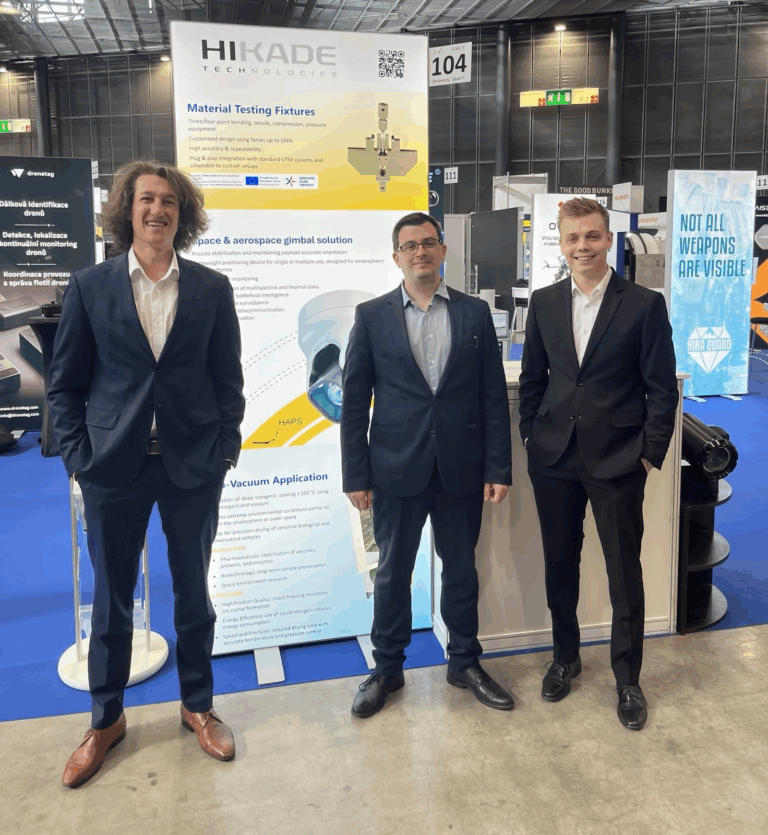
The biggest challenge was – and still is – building a quality team on a minimal budget. The company is all about people, and if I didn’t have the right people around me, I probably would have quit already. I would really like to thank two key people in particular – Mark Melichar and David Nevřivý. They are my right and left hand, no exaggeration. Thanks to them, the whole thing makes sense and has traction.
5. This year your company became part of the ESA BIC Czech Republic incubator and received support from Technology Incubation by CzechInvest. Can you tell us more about the Patron project, which you can further develop thanks to this support?
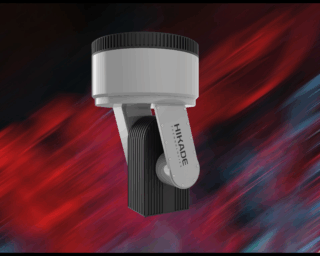
Patron is a stabilizing gimbal designed specifically for HAPS platforms. Its main function is to provide accurate and stable tracking of a specific location on Earth from an altitude of 15-20 km, where any deviation is very visible. The stratospheric environment is extremely
challenging, with temperatures ranging from -80°C to +80°C and pressures around 3 kPa. Thanks to the support of ESA BIC and Technology Incubation, we can further develop Patron and prepare it for practical deployment.
The Gimbal is fully modular and built with an emphasis on light weight, low power consumption and high mechanical precision. It is also unique in that it can stabilize and accurately track ground targets from an altitude of 20 kilometers, making it extremely sensitive to even the slightest deviation. The solution also provides for the full integration of various sensors – from the classic RGB camera to hyperspectral optics. The entire development is being done in-house, as there is simply no such technology on the market yet.
6. What makes your Patron gimbal unique compared to conventional positioning systems?
Patron built with an emphasis on light weight and energy efficiency, which is essential for unmanned HAPS platforms with limited power resources. Currently, there is virtually no commercially available positioning solution that is optimized for the stratospheric environment. While most conventional gimbals are designed to operate in the atmosphere or in space, we had to develop a system that can handle an environment somewhere “in between” – i.e., low pressures around 3 kPa, severe temperature fluctuations from -80 to +80 °C, and long-term operation without service. Unlike space systems that are disposable and unusable upon return, Patron is designed to be fully reusable for repeated missions in the stratosphere.
7. What are you most proud of in your journey so far?
I am most proud of the fact that despite all the difficulties and challenging moments, I have people around me who support me. My wife is a huge support and motivation for me to keep going and see things through. And, of course, to our team – we are still growing and I manage to keep top professionals around me who share the same passion and commitment. It wouldn’t be possible without them.
8. If you could send a message to your “younger entrepreneurial self” at the beginning of your journey, what would you advise?
I would tell myself that it’s important to be patient and not give up, even if the beginnings are complicated and challenging. Success comes gradually, step by step. I like Marcus Aurelius’ quote, “Everything that starts small.”
Thank you very much, keep it up!
Gimbal Patron