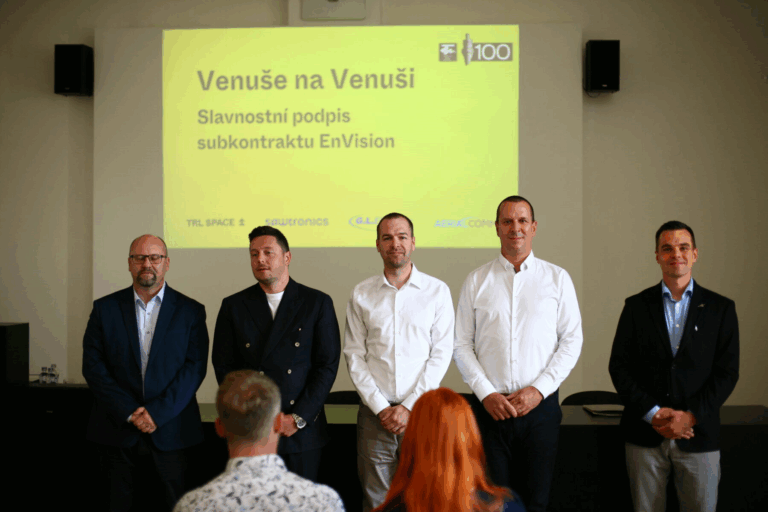
Brno, July 30, 2025 The European EnVision mission is gaining a significant Czech contribution. A consortium of Czech companies — TRL Space, AerialComm, G.L. Electronic and SAWtronics — has succeeded in a prestigious European Space Agency (ESA) tender and secured a contract worth €2.6 million (approximately CZK 65 million) to develop and manufacture a key scientific instrument, VenSpec-H. This device will analyze the chemical composition of Venus’ atmosphere and help answer questions about its past. The official contract signing took place today at the Moravian Museum in Brno. The technology will also carry a symbolic element: the silhouette of the Venus of Dolní Věstonice. This year marks 100 years since the discovery of this prehistoric figurine, named after the Roman goddess Venus — the same name as the planet the European probe is heading to.
The EnVision mission, led by ESA in cooperation with NASA, aims to help scientists understand why Venus, a planet similar to Earth in size and composition, evolved into such an extremely hostile world. The probe will examine the relationship between geological activity and atmospheric chemistry, contributing to our understanding of how two similar planets can take such different evolutionary paths. The launch is planned for December 2031. Czech engineers and researchers are playing a significant role in developing VenSpec-H, one of the mission’s key infrared spectrometers.
“Czech experts are a full-fledged part of top-level European space research. It’s proof that we have the know-how to succeed even in the most prestigious international missions. Our participation in EnVision shows that the Czech Republic is capable of contributing to complex projects with global impact and being a reliable, respected partner,” says Václav Kobera, Director of the Department of Space Activities, New Technologies and Innovations in Transport at the Ministry of Transport.
Four Czech companies are working together on the development and production of the instrument under the leadership of TRL Space. “This is an important milestone for us that builds on our long-standing efforts to be involved in European scientific missions not only as suppliers, but as true co-authors of the solutions,” says Petr Kapoun, CEO of TRL Space.
In addition to managing the project, TRL Space is also responsible, together with SAWtronics, for developing the device’s electronics. Functionality testing will be carried out by AerialComm, a member of the TRL group. Final assembly and inspection of the electronic boards will be handled by G.L. Electronic.
“Working with Czech developers is valuable not only technically, but also in terms of European scientific integration. We appreciate their professional approach, constructive communication and ability to contribute to international coordination from the early stages of the project,” says Eddy Neefs of the Royal Belgian Institute for Space Aeronomy, which is responsible for the overall scientific design and coordination of the VenSpec-H instrument.
This group of Brno-based companies will cover the entire process — from design to the production of the complete electronics for the VenSpec-H instrument. They will prepare several test units and one final version that will be part of the probe headed to Venus. Without this electronics, the instrument would not be able to function. It ensures the ability to collect and process scientific data.
“We’re already developing models and simulations of what the spectrometer’s data will look like in real orbit conditions. Our goal is to interpret the atmospheric spectrum correctly from the very first transmission,” says Martin Ferus from the J. Heyrovský Institute of Physical Chemistry at the Czech Academy of Sciences. “Industry collaboration is absolutely essential in this project. Without the technical facilities and expertise of companies capable of designing, building and testing electronics to strict space standards, we as a research institution wouldn’t be able to participate at this scale. That’s what allows us to not only contribute to the scientific concept but also influence how the final instrument will perform under real conditions in orbit.”
source: ESA BIC Czech Republic